Career Direction
My current position and role.
I’m currently exploring my next chapter — open to the right opportunity while also seriously considering building a D2C brand of my own.
After driving 51.9% revenue growth in my last role, I’m looking for a place (or a project) where I can create that kind of impact again, this time with even more ownership over the outcome.
To me, what work I do and where I spend my time is still deeply important.
My goal remains the same: keep learning, keep upskilling, and create real value wherever I land next, whether that’s for a company or for a brand I build myself.
I continue to focus on the skills that compound – AI-driven automation, brand-building, and full-stack execution from design to code to growth.
This is the chapter where everything I’ve learned so far gets tested at a bigger scale.
Chapter 01
The Start
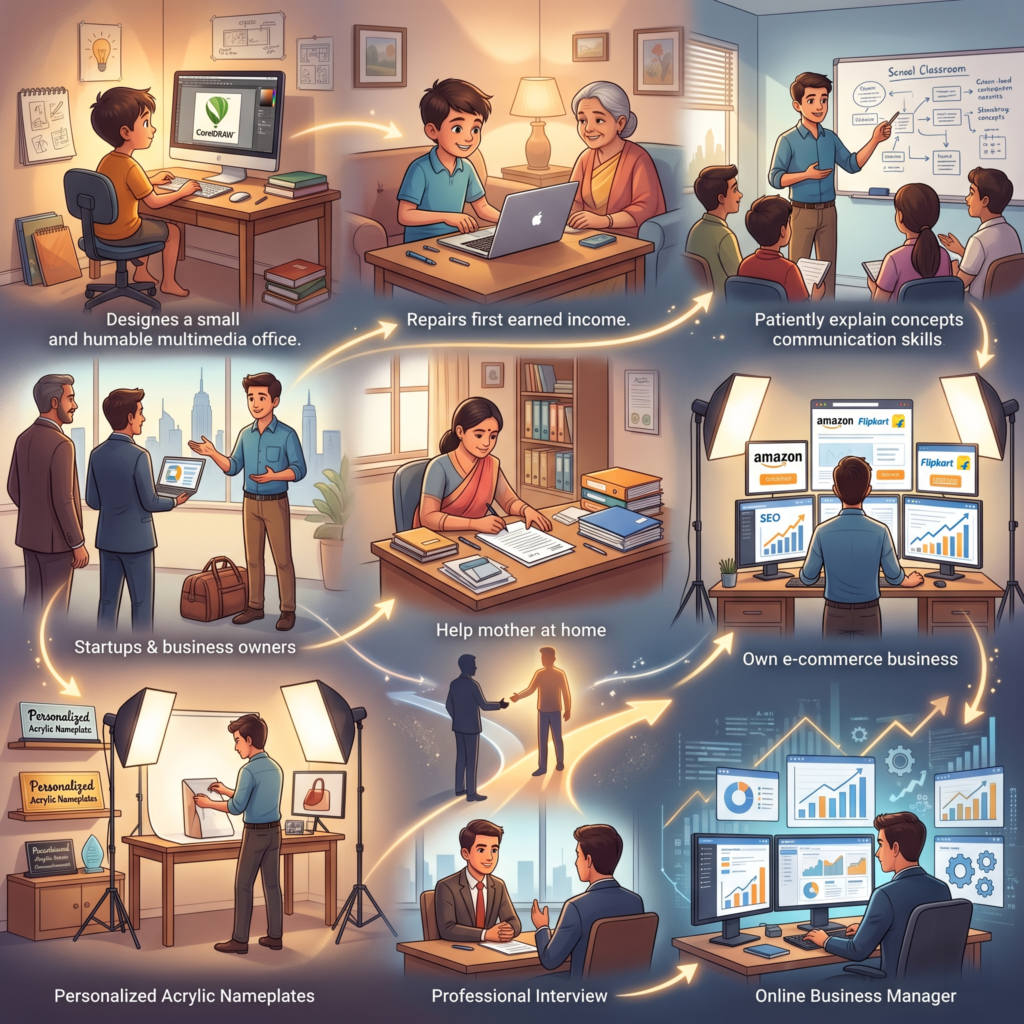
My first job was at my uncle’s multimedia business. I joined mainly to learn and help him out, and that’s where I got my first real exposure to CorelDRAW, graphic design, and project management. Looking back, it was the perfect place to begin. I was still young, so there weren’t huge expectations placed on me. That gave me the freedom to make mistakes, ask questions, and focus on learning instead of worrying about being perfect.
Around the same time, I started doing small freelance jobs installing software on laptops. The pay wasn’t much, but that didn’t really matter. It was the first time I had earned money from a skill I had learned myself, and that feeling gave me a lot of confidence.
My mom used to run tuition classes, and I initially helped her manage the younger students. Before long, I found myself teaching English, History, and Geography to students in the 9th and 10th standard. It was something I genuinely enjoyed. Teaching helped me become more confident while speaking in front of people, and it taught me patience, empathy, and how to explain complicated ideas in a simple way.
During that period, I also worked at a startup that developed management software for schools and coaching classes. My job involved training school administrators and owners on how to use the software, assisting the sales team, and sharing feedback with the developers to improve the product. Eventually, I decided to leave because the job required constant travel, which became difficult to manage.
Even though I didn’t stay there for long, the experience taught me a lot. I got to see how a company functions behind the scenes, how different teams work together, and what happens when communication breaks down. The company struggled with coordination between management and developers, and seeing those challenges firsthand showed me how important good leadership and clear communication really are.
Later, my mom became a lawyer, and while I was still completing my studies, I helped her with legal documentation, registrations, and filing work. Instead of taking up another full-time job, I chose to support my family in this way while continuing my education. It was a different kind of responsibility, but one that taught me discipline, attention to detail, and the value of being dependable when your family needs you.
Skills I learned from this stage
Project Management
While working at my uncle’s office, I learned the importance of project management. Without proper processes and management, it is very difficult to scale and keep track of projects and tasks.
Designing
I learned CorelDRAW, and because I wanted to become a good designer, I started exploring some of the best designs I could find online and learning from their use of fonts, colors, spacing, and more.
Importance of Proper Communication
The most important thing I learned was how to communicate clearly. Whether you speak in Hindi, English, or Marathi, it doesn’t matter as long as the other person understands you perfectly.
Chapter 02
Building Something of My Own
After I graduated I co-owned a company where I was in charge of marketing and the online business. It was an e-commerce venture for customised acrylic products such as nameplates, signboards and personalised decor. The business grew exponentially and we became top sellers for multiple products across India.
I was responsible for presence across Amazon, Flipkart and IndiaMART, handled product photography and optimized every listing with SEO. I built a website that ranked #1 for several keywords in India and proved the fundamentals were working. I then went on to add production and sourcing of materials, running much of the business end-to-end.
I created content for our social media presence to build trust and share our story with the world – not just to sell, but to let people see the person and process behind the product. It worked: I grew our accounts organically, eventually reaching 469K+ monthly views on Pinterest alone. That taught me that authenticity, shown consistently, compounds faster than any single viral post.
I wanted to build the company into the definitive brand for customized acrylic products in India. But my vision and my business partner’s didn’t align, and I eventually decided to leave. I felt I couldn’t grow to my full potential there. It was a hard call to make, but looking back, it was the right one.
Key skills I learned from my first business

SEO
I believe one of the most important and underrated things is having a proper product listing with the right keywords. Focusing on attracting organic traffic can be time-consuming, but it is the best approach for long-term growth.

Branding
Creating a strong identity using the same fonts, consistent photography and videography, a unified design language, and a clear story is the key to building a generational brand. People connect with stories, and as a brand, I learned how to convey that story effectively.

Web Development
Because we had a limited budget, I had to build the entire website on my own. I knew the basics of building an e-commerce store, but whenever I got stuck, I Googled and used YouTube to figure things out.

Relationship & Management
Building strong relationships with vendors and delivery partners was one of the most important parts of the business. We had to manage cash flow, get supplies on time, and dispatch products efficiently to keep everything running smoothly. Since there were only two of us running the company, proper management was essential for scaling.

E-Commerce Marketplaces
I learned how to create product listings, outrank competitors, run ads, and add offers. Managing a marketplace is easy, but to grow, I had to keep a close eye on competitors.

Social Media
We focused on building authenticity, sharing our story, engaging with customers, and showcasing new products through social media. This helped us reach and connect with our audience effectively.
Chapter 03
The Growth Chapter
I applied for a data processing job in a UK based company through Naukri.com. I was interested in the role because it offered a chance to improve data at a fundamental level that could drive company growth.
I was short-listed and did some further digging into the company to find where I could add value. The interview was with the owner, it went well, I stuttered a little but made it clear what value I could bring and ideas for improvement.
I think the most important part of the interview was that our energies matched immediately. I had already looked at his YouTube channel and knew he had a mentor mindset and not a boss mentality. He saw that I had the potential and created a new role for me and asked if I could double the business by the end of the year. I thought, maybe, it was possible to be done. I thought about it and said, yes.
Then I became an Online Business & Marketplace Manager, which has been one of the most important opportunities of my career so far. My mentor taught me a lot, and I applied his advice directly. I was struggling a little to keep on top of things when I was doing a lot of things at once and he recommended writing down everything you have to do and think about – which really helped me to be more structured and clearer in the way I work.
In this role, I enhanced product listings, improved images, worked on the website, added blogs, and automated the creation of newsletters and social media content using AI tools such as Claude. I ran ad campaigns and through consistency and focusing on quality, I began to see real results.
And I didn’t stop there – I created my own AI chatbot from scratch, including creating its own knowledge base, and did a complete redesign of the website using the assistance of AI. I also got involved in recruitment, helping in the interview process to build a strong team. I was in the habit of upskilling myself on a daily basis, more importantly due to the rapid development of AI and the need for its implementation properly which can really give an edge to a company.
By the time I moved on, I’d grown a lot – not only in skill development, but in my own concept of ownership, structure, and long-term building. I appreciate the mentoring and faith invested in me, and I bring everything that experience with me to what I will build next.
Skills I learned from this opportunity

Ads
I created assets, researched my target audience, selected the target locations, and added keywords, headlines, and descriptions. In the first month, we got good sales and a positive response from the ads, which felt great because if they hadn’t performed well, we could have lost money.

Automating Newsletter
After some research, I learned that Mailchimp supports HTML, and now I create entire newsletters using Claude AI. It has drastically sped up the process. I give Claude context about me and my company, write down my ideas, and then explain the output I want, and it handles the rest.
Image Generation
Generating high-quality lifestyle images of our products was very important because the first thing customers notice is the product image. I had to clearly convey how the product would look in a customer’s home and its use case. I experimented with several prompts on Google Gemini and then created a master prompt that could consistently generate high-quality images using Nano Banana Pro.
AI Chat Bot
I built a custom AI chatbot from scratch – including its own knowledge base – to handle customer queries and support. This taught me that AI isn’t just a productivity tool; it can become a real product feature that customers directly interact with.
Structured Thinking & Organisation
I used to struggle with staying organised while juggling many things at once. My mentor suggested writing down every task and idea instead of carrying it all in my head – a small habit that completely changed how clearly I could plan and execute.

Hiring & Team Building
I got involved in the hiring process, conducting interviews to help build a stronger team. This taught me to evaluate people not just on skills, but on energy and mindset – the same thing I noticed mattered in my own interview.
Proof